if a tree falls
Roman Susan at 1224 W Loyola Ave, Chicago IL
February 2 - February 28, 2024
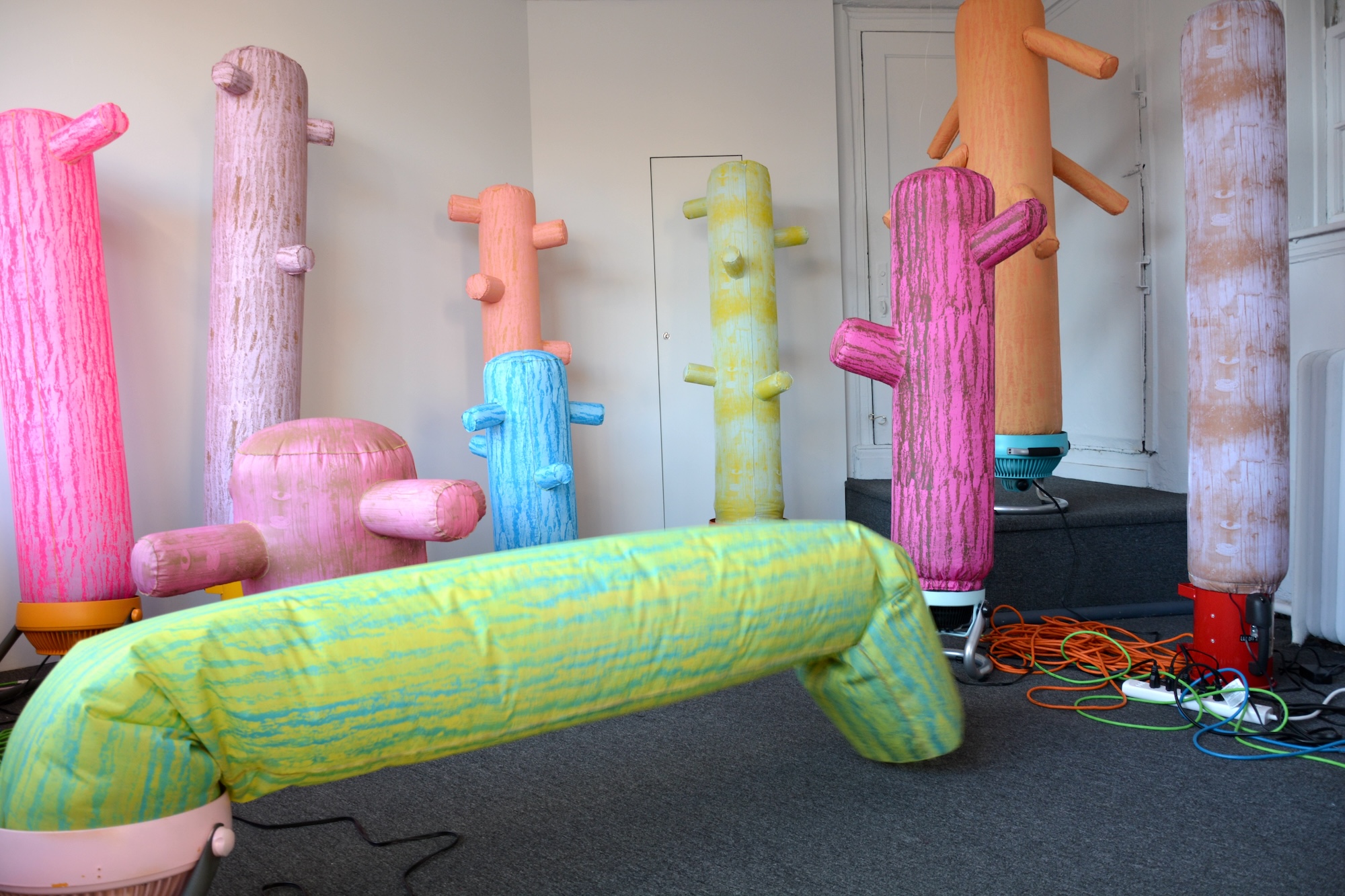
What was if a tree falls?
if a tree falls was the title of my solo show. The title really emerged from that phrase, If a tree falls and there's no one around to hear it, does it make a sound? I was thinking about that phrase, this really human experience of nature, and this idea that nature wouldn't make a sound if there wasn't someone present to understand it or to hear it.
I was thinking about how a human presence can define a space as nature, even if it's not necessarily a picture of nature or what someone would paint if they wanted to paint a scene of nature. I was thinking about how to bring together this kind of experience of Edgewater, as a neighborhood, which to me is a neighborhood that's really steeped in nature. There is also this conflicting understanding of Chicago as a city and a garden, but Chicago as a space where there isn't much nature, if you're comparing it to a forest, mountain or large naturescape.
I used images, photographs that I took of trees and telephone poles from around Edgewater. I turned those photographs into prints that I screen-printed on fabric and turned into inflatables. I transformed the inside of Roman Susan's space into an environment filled with these inflating trees that inflated when they sensed a human presence. They were triggered by a motion detector. Whenever someone passed by Roman Susan, they inflated and vibrated. They had a lot of energy, movement, and sound to them. When nobody was around, they were still, silent, and deflated. That was, to me, bringing that kind of natural relationship and the way that a human can define a space as nature into a more physical form.
How did the pandemic inform this project?
Over the pandemic, I was at home a lot. I know a lot of my friends were at home a lot, too. I am immunocompromised. I don't want to get COVID, and I don't want my community to be harmed by sharing or transmitting COVID. I spent a lot of time inside and yearned to be outside. I was yearning to experience a natural space or a space where I'm immersed in my environment.
I was talking to my friends, and they would say, “I haven't been in nature in so long. I really need to go to nature,” I was thinking about nature as a place to go, a specific place, a memory. That made me really focus on the idea that nature is whatever a human can define it as. I tried to shift my understanding of nature and really recognize that there are natural environments everywhere.
Outside of my window, I have falcons that live in my building. They've transformed my human space into a full environment. There are other creatures, beings, and organisms that live throughout the city. It's a really natural space.
What is your definition of nature?
My definition of nature is any space that has a relationship to different organisms interacting. If there's something alive and interacting with something else, I feel that that's a natural thing. Outside of Roman Susan, there's a lot of concrete, inside of Roman Susan, there's a lot of drywall. It's a really natural space because there's a lot of interaction that's happening there and a lot of different organisms that call that corner and that space home.
How did you respond to Roman Susan’s floor plan and site?
The first thing I really responded to was the window. I knew I wanted to engage with that window as a way to draw people in and to break down the wall between the space and the sidewalk. I knew that whatever I made, I wanted it to be something people could experience, no matter what time of day it was. Responding to that, I was thinking about how I could place the motion detectors so that people can activate it from outside or inside of the space.
I know those windows, every time someone walks past, they're looking in and they're experiencing something different. I wanted it to be something accessible inside and outside of the space. I thought about the motion detectors first. From there I was thinking about how I could have that motion of the inflatables, sometimes a small motion and sometimes a big motion. I didn’t cap the central inflatable I had in this show. I didn't seal it off. What that does to the motion – it makes it really dance kind of wildly and almost collapse. It was a lot of movement. I wanted that range of movement, I wanted it to fill the space with the inflatables and create a stand of trees, like a clearing in a forest for people to step into when they're inside of the space. I lined the walls with the inflatables. I had the dancing inflatable in the center, like they were the centerpiece, moving around.
In terms of my color palette, I'm really inspired by unnatural things. I really like human objects, power tools, and extension cords. I leaned into the idea of kind of artificial colors or plastic colors – things that are less present in nature and less present in trees. In my color palette, I went more towards pink and a neon color palette in my print and my dye in the fabric. I had extension cords, of a bunch of different colors, on the floor. I was thinking of that as a root system that's connecting all these trees and helping them communicate and share energy.
Why trees?
I love trees. But I also think that trees are a really great bridge between a human and nature. The way that we describe trees and the way that we humans are really similar, like a trunk: a human trunk and a tree trunk, human limbs and tree limbs. I was thinking about the inflatable form of a tree, I realized how similar that form is to the dancing inflatable humans, like the ones outside of a car wash or a gas station.
I was thinking about the way that the movement of these forms and the movement of trees can echo the movement of humans. They look very similar to a very simplified human form, an upright tube with limbs.
But also, I just love trees. I've always loved trees ever since I was little.
What was your photographic and printing process?
I went on walks around Edgewater and Rogers Park. I was taking pictures of trees. My friends often comment that I interact strangely with trees because, instead of just looking at them for their form or looking at them from further away, I like to look at their bark really up close and notice things about it. When I was walking around, I would notice the bark on tree trunks, and I took pictures of it using a camera. After I took a lot of pictures, I noticed that there are a lot of streets in Edgewater that have trees on both sides that go all the way down the street. Then, when you turn the corner, sometimes you'll look down an alleyway and you'll see telephone poles all the way down the alleyway, lining it in a similar way to the trees.
I also took some pictures of telephone poles. I was just enjoying the texture. I was thinking about these corridors of trees and telephone poles having a relationship. The telephone pole also has the same form as a tree with branches and a trunk. They are made of wood, which is really being made out of a tree. I wanted it to be its own kind of artificial tree.
I took those pictures home and I turned them into a single color print by bit mapping them on Photoshop. I cut them so that they repeated. They fit together like a puzzle piece. After that, I exposed those prints onto a large screen for screen printing. I printed it onto ripstop nylon by hand. I sewed the nylon, and I used a sewing machine and thread, then attached them to the fans. I really like using just normal household fans when I can because I think they're just interesting objects. I used a mixture of inflatable fans and house fans for this show.
Where does this project sit within the context of your practice?
Before the exhibition, I had just graduated and I wrote a thesis research paper, which was the longest thing I've ever written. That thesis was bringing together scientific research about trees, along with my family history, like a personal narrative memoir, and then philosophical thoughts on trees.
In that research, I discovered that trees can see. Trees can sense the world around them. That’s how they grow. They're looking at and understanding the colors of light. That's why they bend in certain ways or their branches extend in certain directions. That got me really thinking about sensing and seeing and how I could create trees that were seeing or looking or understanding the space around them.
I was making some inflatables at the time, just as the beginnings of experimentation with this process. Getting this opportunity to create an installation let me bring that research together with my making and turn that paper into something that felt l tangible. Through the process of making these pieces and installing these pieces, I got really interested in the aspect of sensing and the sound of the environment. I am interested in the way that the fans filled the space with noise, then everything went quiet. The noise influenced people in the space. I remember at the opening, it was noisy. Whenever there were fans on, everyone was talking really loudly. The noise of the space influenced how people spoke. When the fans turned off, everyone felt like they had to get quiet.
The noise of all the humans changed. It was really fun. Now, I'm interested in how I can create more of those interactions, where humans are being controlled by their environment, and where environments are being controlled by humans. I'm interested in performance as well, how performance and different ways of activating installations can be a larger part of my practice.
While I was preparing for this show, Kristin lent me a bunch of physical supplies for working with code and learning to control currents of electricity to control this installation. I did a lot of experimentation and learned a lot using those supplies. That has really informed my practice. I want to do more coding now.
What has your relationship to Roman Susan looked like?
It was so wonderful. I feel like Kristin and Nathan are so supportive. For me as a pretty young artist, just making things and experimenting, being an artist outside of an institution. They were very friendly and supportive of what I was making and offered their advice, time, and expertise, which I really appreciated.
I just love that they created this space in the area. I don't feel like there are any spaces like Roman Susan, period, but also not in Edgewater or Rogers Park. I saw them many times before, at other art events and other art spaces. They've always been so supportive and caring as people.
To me, Roman Susan has brought so much art into this neighborhood, but beyond bringing it into this neighborhood, it's highlighted the art that thrives here. I know so many artists who live in Rogers Park and Edgewater who are able to create projects because of Roman Susan. Who would just always attend their shows. They have amazing shows and activations. There's always something going on that's always open to the neighborhood and bringing in people who are artists, and everyone who lives around. It's a real community space.
What role does Roman Susan play in Chicago?
Roman Susan is a real artist-run space that supports artists at any stage of their career and is a hub connecting people and creating opportunities for anyone to create something. I think it's really empowering and also something that doesn't exist in many places.
Providing financial support to artists and making sure that everyone involved in everything gets paid is admirable. It inspires me to create more opportunities for other artists to get paid and compensated for their work.
I think Kristin and Nathan are inspiring people, and that inspired a space that brings people together and offers them things that you can't get anywhere else: those tangible supports like money, the loaning of resources, the physical resources, but also friendship, support, and mentorship.
What is it like being an artist in Chicago right now?
A lot is going on in the larger world that is very impactful, it is important to take care of your community and take care of the people around you. But it's also so inspiring to see everyone making things. No matter what's happening, everyone's still making their work and using their creativity, skills, and resources they have to support the people around them.
It's spaces like Roman Susan that inspire people to have generosity and care for their community. Everyone I know has a bunch of different jobs, which is hard when you're making things. But there's always time to make things and there are always people who are willing to help you make what you want to make. Building that community with you is really important. I think Chicago has that community, which is really special.
What do you have going on right now or in the future?
I am running a summer camp. So a lot of kids. I am co-president of Terrain Exhibitions, and our Biennial is coming up this fall. There's a lot of planning for that. I'm very excited about all of our projects. I'm helping to organize everything right now.
I'm also going to grad school, which I'm very excited about it. I’ll be going to SAIC to study art and tech. I would say the credit for that comes from this show, a new understanding of my practice, where I want to go with it, and an understanding of myself as an artist.
I am very excited about that and looking forward to making more work, continuing to support my community, and being a Chicago artist. I also have a piece in the Rockford Arboretum for Art and Tree Science. It's a collaborative piece I made with my mother, which is a ceramic sculpture; it's a family tree.
Other artist histories: hiba ali // Julietta Cheung // Kandis Friesen // Steven Husby // Juan Molina Hernández // Kevin Norris // Ruby Que // Olive Stefanski // Chiffon Thomas // Gwyneth Zeleny Anderson