Qualiascope
Roman Susan at 1224 W Loyola Ave, Chicago IL
November 18 - December 6, 2014
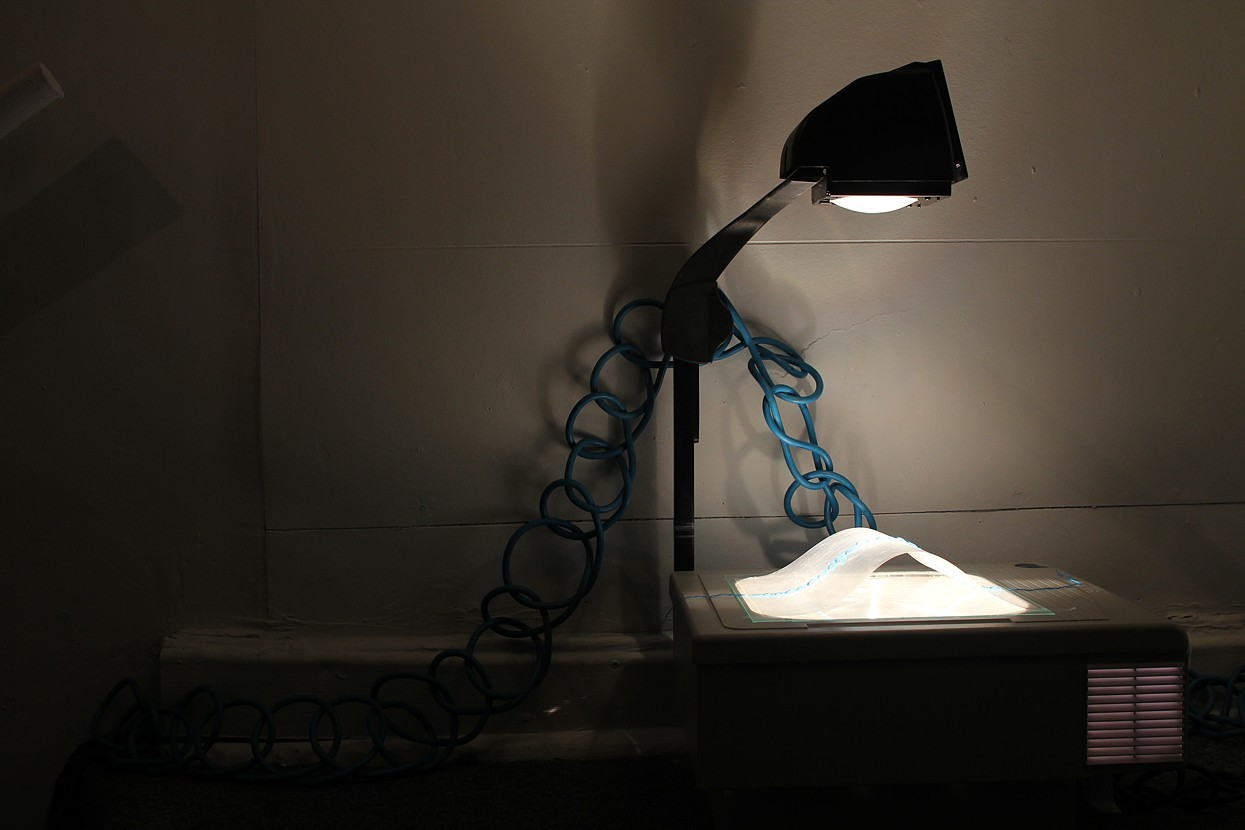
What is qualia?
Phenomena that can't be measured or quantified. It's purely experiential. My art practice is often about sensations, feelings that don't get termed as objective reality. Qualia speaks to that subjectivity.
Like the feeling of a stubbed toe. There isn't a tool to measure the pain of that. In doctors' offices, they'll give you a scale from one to 10 to measure how painful something may be. But it's not a true measures the actual phenomena.
What's a qualiascope?
I had found the term qualia, and I thought, that's what my art is about. I wanted to try to measure qualia, depict them as if they are something observable and measurable. I came up with a qualiascope. But then I did a Google search, and it's also a term used in the book, “A Voyage from the Brain to the Soul”, by neuroscientist Giulio Tononi. In that book, it's a hypothetical device that measures information of the surrounding spaces and things. I wanted to do that at Roman Susan.
Can you describe the qualiascopes that you exhibited in this project?
There's a sound piece that is a real thermometer next to four headphone jacks embedded in the wall. There were headphones with an aux cable that you can plug into the holes. That one is called “aural thermometer,” it's a-u-r-a-l: a sound-based thermometer. I positioned the headphone jacks equidistant from one another, spanning the whole length of the thermometer. If you plug in the headphone jack at these different intervals, the lowest one would be the lowest temperature, you’d hear a series of sounds- pops or clicks with space in between them.
If you were to then put the headphone jack up to the next one above it, it's a bit faster. At the very top, it's very, very fast. With that, I was thinking about two things: how heat works, the faster movement of particles resulting in warmer temperature. The whole show was really using frame-by-frame animation as a way to put the viewer in control of the rate of movement of most of the artworks. I was thinking about that rate of movement that is also intrinsic to temperature.
I was also thinking about the bouncing ball, which is kind of ubiquitous to traditional animation- and imagining each sound as a kind of ball bouncing, hitting a surface.
How did the closing screening function in this project?
The project was a series of these mostly interactive sculptures, and in addition to that during the run of the show, I created stop motion animations of all of the pieces. The closing event was a screening of that animation within the space.
How does this project, over 10 years old, connect to your greater art practice?
It feels very relevant to what I'm doing today. Over the years, I've been increasingly making interactive and sculptural, installation-based artworks that refer to the frame-by-frame animation process. Often these pieces don't rely on that illusion of motion that involves a screen and playing it back.
With Qualiascope, I wanted it to be an experiment in empathizing with a place, playing with modes of attention. I wanted it to be an experience of the phenomena of this space. I continue to relate to sensation as if it's a tangible, measurable, external phenomenon.
Trying to perceive one's own sensations, beliefs, narratives, the kinds of things that we internally hold that have reverberations outside of us. I've continued to do that, trying to look at one's own internal experience as if it's a morphing shape, when so often we don't perceive those experiences consciously. Those sensations and discomforts can dictate our beliefs and narratives. We are directed by feelings, which can obviously lead to real harm. Qualiascope was trying to hold and slow down perception, which I continue to do, to try to watch perception itself. I think it's critical for living in a world with other beings and for living with oneself.
How did you react to Roman Susan’s unique space and floor plan?
The show, maybe right before mine, had a mirror that was positioned in the window and had burned the carpet in the space. The entire floor is a worn out blue carpet. It's not a polished space. That felt in line with the project, where everything's in a state of slow decay or transformation, the sun melts the floor. I think of that as being very much like a body. Our bodies are not pristine white cubes. That space speaks to the sort of messiness of being a body, a shape that changes over time. Also, there is a boarded up window on the wall facing the alleyway, and due to that square of a thinner barrier, you can hear anyone outside talking very clearly for just a moment as they walk past. That experience showed up in one of the artworks.
Outside of Qualiascope, what has your involvement with Roman Susan been?
It's been one of the most meaningful relationships in my life! I've had the opportunity to share my work at Roman Susan in group shows and performances 8 times, aside from Qualiascope. I'm so grateful! And Kristin and Nathan are close friends of mine, it's a friendship that was born out of Qualiascope. We met because I proposed this project. I also served on the board when they officially became a nonprofit. Three years after Qualiascope I moved to Rogers Park. I've shared multiple studio spaces with Kristin. I found kindred spirits in the two of them.
I went to SAIC for my undergrad. When I graduated, I felt alienated and straight up scared of curators. I felt a giant gap between me as a weirdo artist doing my thing and desperately wanting to connect with audiences. At many art openings I was hyper aware of a social ladder that I was supposed to try to climb. That feeling was and still is icky… I doubt many people love that aspect of making art. I had also had a bad experience a couple years prior with a curator who had yelled at me.
Once I got to know Kristin and Nathan, it was kind of the first experience of being like, oh, we understand each other. I feel respected by you. I feel like I can be myself with you. The ethos of Roman Susan as a project aligns with how I think about making art in a place. There's mutual respect and genuine curiosity.
What did it feel like to be an artist in Chicago in 2014?
It felt tiring and hopeful, kind of sparkly. I would sometimes work three teaching artist jobs in one day: south, west, and north sides, travelling by CTA. When I wasn't teaching, I'd be at my studio in Garfield Park. I could hear neighbor goats outside and I'd go on the roof even though it wasn't allowed, roller skated a few times up there. The studio building was equally populated with young artists like me and more well-known, established artists. I dealt with a lot of social anxiety and preoccupation with a situationship, which unfortunately prevented me from connecting deeper with more folks. I didn't pay much attention to art made by people I didn't personally know, other than shows at the MCA where I was working as an artist guide. I prioritized making my art and learning how to be a friend, to hang out and feel like myself around people, something that had previously been really hard for me. That year my roommate and I lived in a tiny apartment in west Pilsen and people would stay late making bread pudding with us. Just in 2014, we went through a whole bread pudding phase.
That year I was an artist in residence at the Experimental Sound Studio, Alex Inglizian helped me hack a slide projector and record many sounds for an interactive animation sculpture, similar to Qualiascope in that it was depicting invisible airborne matter from the Fisk Generating Station in Pilsen. It was one of the most generous experiences, receiving support on that project. It was actually starting to feel like a real artist engaged with Chicago. I was starting to feel like I was a part of this city, I felt less disconnected.
You had another solo project with Roman Susan, Thaumatropes!
This was a video installation that was in the window, facing the alley towards the train. It was a loop of videos of me twisting thaumatropes I made. Thaumatropes are considered the earliest animation object: it has two images on it, a picture on each side of a circle, with strings on each end. The familiar version of this is a bird on one side and a cage on the other. As you twist the strings, it looks like the bird is inside the cage. It can also be something like a GIF, a two-frame animation, like a bird with their wings up and a bird with their wings down. When spun, it looks like a single bird is flapping their wings.
Nathan invited me to create work using the archive at the Rogers Park Historical Society, I had access to many photos. I printed some out and paired images to make thaumatropes with. It was mostly photographs of people, but some of places, landmarks. It was really kind of an experiment in collage through an animation object, animating local history.
What do you have going on now and in the future?
I'm currently in the sculpture MFA program at Tyler School of Art, so I've been making things quickly and messily. I recently made this interactive sound sculpture of 5 metal chairs hooked up with contact mics and bass speakers, creating a loud feedback loop. People can sit and physically feel the person sitting next to them, as well as listen to how the sounds change depending on people's positions. If you leave the chairs, they scream: bodies absorb the higher, louder frequencies. I also choreographed a dance, a meditation on another kind of loop: the trope in cartoons where one character chases another until they're confused who is chasing who. It's a loop of desire and avoidance that many of us get caught up in. I made a series of acoustic props for it, so that the dancers' movements provided the soundtrack. I've been trying to push my practice to incorporate more sound-based works, and increasingly I want to make work that is only complete once a person is engaged with it.
Something in the future other than my thesis show is "hosting" a day at Roman Susan for the final week. Visitors will be invited to create morphing sculptures out of wet sand while listening to dreams, audio recorded by people in Roman Susan's orbit. It'll be a time for observing what we create when we're not trying to create, what emerges during an ending.
Other artist histories: hiba ali // Tallulah Cartalucca // Julietta Cheung // Kandis Friesen // Steven Husby // Juan Molina Hernández // Kevin Norris // Ruby Que // Olive Stefanski // Chiffon Thomas