Eveningnessless
Roman Susan at 1224 W Loyola Ave, Chicago IL
December 27 - January 5, 2025
What was Eveningnessless?
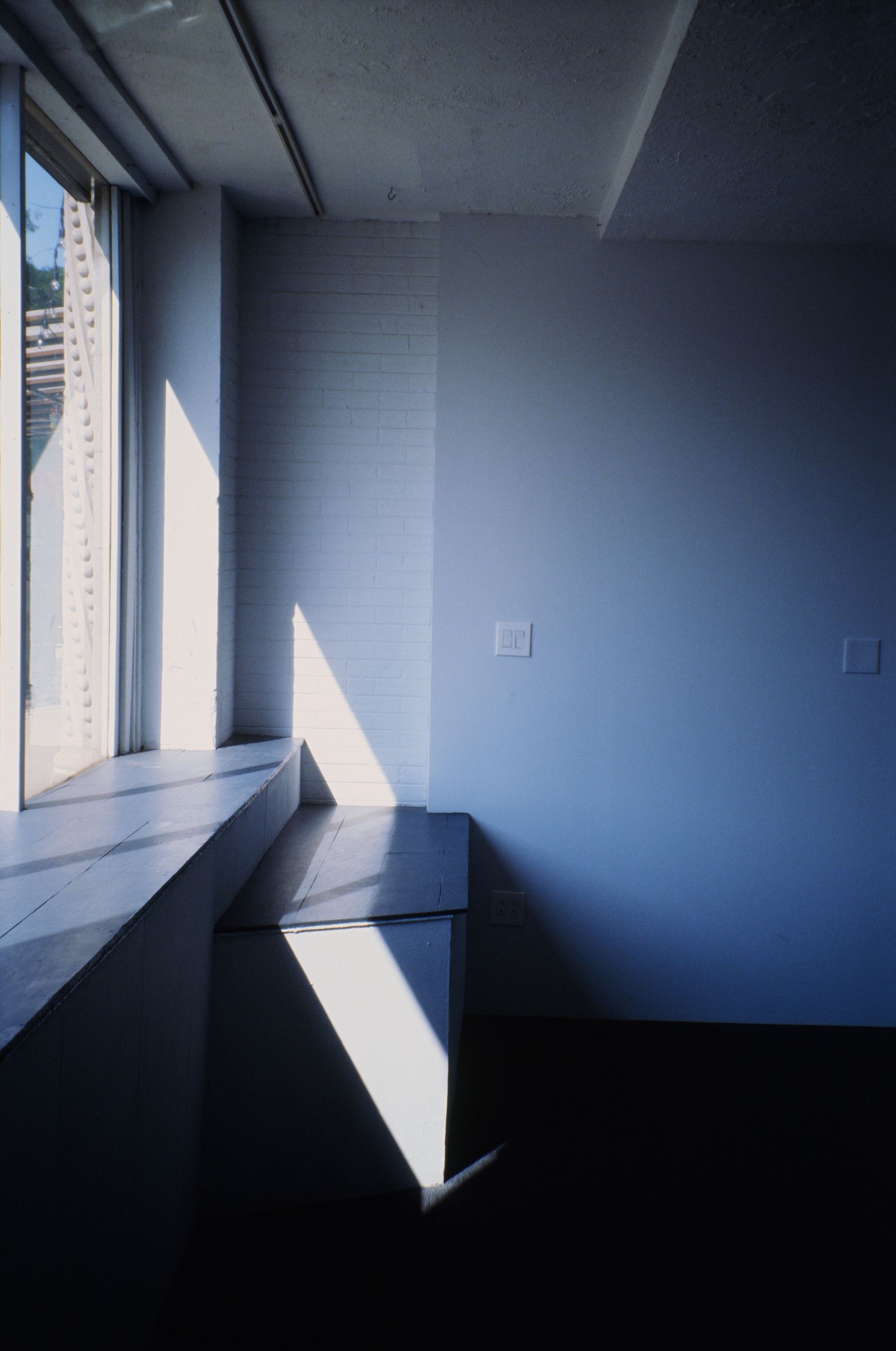
I have been doing a series of works where I document the light movement in the spaces that I occupy, whether that be a studio, an apartment, a living space, a residency, or a workplace – all of these temporary abodes, basically. Last August, during the hottest days, I was in Roman Susan for two days from sunrise to sunset and some time after. It was the weekend that Archie’s was closing, so there was a lot of celebration going on. I stayed at Roman Susan for two days and watched the sunlight move across the space.
I documented those lights with video, photos, some written words, and drawings. This was translated as one 11-hour video and 11 photographs that were projected on a slide projector. There were 11 35-millimeter slide photos. The slide projector was moving so that each day the projection would land on the spot that was in the photograph. I included three pieces of handmade paper that are in the shape of the gallery. The idea is that when they're hung in the window, and sunlight is passing through them, the shadow they cast is in the shape of the space. I also had a deck of postcards that were the same photographs as the slides that people could freely take as a souvenir. There's a small video on the big projector, but it's sped up; it's only an hour long. It's just the shape of the light isolated, mapped out from the surroundings, and it's being projected on an hourglass that was regularly flipped over.
When I was doing the Storefront Residency, it was Archie's last weekend. I stayed after Sunset because bands were playing outside, people were dancing, and the shadows were moving on the wall. I also got to meet a bunch of people at Archie's and talk to the owners about their space closing. We were commiserating in this act of remembrance. Being there during that celebration also felt like a significant part of the project and set a tone for documenting the light for this show.
Do you view light as a performance?
I view light as something that we all see, but it's almost democratic because you can hold it, you can preserve it, you can keep it for yourself. It's something that we all share and notice.
How did you react to Roman Susan's unique floor plan?
The slide projector, which was projecting the photographs with light moved in the gallery, would lead your attention to different corners of the gallery. Even though there isn't sunlight, the slide projection was visible. It's kind of like reenacting and reanimating that corner of the space, which is shown in the photograph.
When I was doing the storefront residency, Nathan stopped by, and we were talking about these tiny moments of light that we both noticed. He told me that he’d watched this light for years and noticed and remembered its patterns and that he was glad that someone else could also remember these moments. There is this very brief light that lands on the bathroom door, right on the s hook at the bottom, it's only there for like 10 to 12 minutes every day, and it felt really precious to like be able to see that and capture that.
It is a personal act of remembering how the space felt. This light is something that is also not replicable, right? It's a similar pattern, but every day it changes a little. And the quality of light is different. When people pass by or when there's a building across the street with an open window, all these things are changing the pattern of light. I think every day you take notice- this act of witnessing feels important and precious.
What is collective myth-making?
I think a lot about how when we all believe in a thing, it becomes real. It becomes real for a certain small group of people, and it becomes like a shared memory. Memory is very malleable, and truth is subjective. I was doing a lot of these performances, talking about light, how it can't be kept or documented. Whenever I do a performance with light, people notice different things, and people remember different things. It felt like a secret that only participants present could share.
I'm thinking about how this could be a form of empowerment. I grew up in Hong Kong. In the Hong Kong protests, there is this way of communicating where people would talk about, “Oh, last night I dreamt that at 6 p.m. I was at this park with my friends, and we were doing these things.” But in actuality, what they were saying is that tomorrow at 6 p.m., we'll gather at this park with these people, with these things, and we'll do this, This flip between dreaming and constructing a memory that wasn't there is really interesting to me. That felt like an act of collective myth-making that actually makes its way into reality. If we all believe in a thing, then it can be real. It's a way of building a future.
Can you speak to your use of both objects and light in conjunction?
I feel really sentimental about this show. I usually only work with light. For the postcards, it felt important that people would have something to take away and remember the show and remember the space by. The paper was a last-minute decision. I was taking this papermaking workshop, and the act of making these shapes with your hands was so physical that it felt like the opposite of what I was doing for the show already. Adding those moments with objects and touchable collectible things was like a sentimental addition. It complements how the main element of the piece is very fleeting and ephemeral.
I collect hourglasses when I'm on trips. I use them a lot in my performance work. I like the way the projection shoots through the hourglass because the glass cannot hold light. It shoots straight through, but it distorts it. Adding it was a pretty last-minute decision, but it just felt right.
Where does this project sit in the greater context of your practice?
I was doing a series of work to document the light patterns in different spaces that I occupy. When I was right out of grad school, I did six residencies in a row. I lived in six different states, six different apartments, six different studios. I was moving around a lot, living out of two suitcases. I felt like there was nothing I could quite hold on to. It felt like a very transitory period of my life.
When I came back to Chicago, I was still thinking a lot about this. When Roman Susan asked me to do this show, I wanted to continue this body of work. It felt aligned with the time that Roman Susan was closing and how, to me, is an act of grounding for myself and remembering a space. But at the same time, it doesn't produce anything physical to be kept in memory, and so much of it is about remembering a gallery that was important to so many people.
This is the last piece in this body of work. None of the other documentation has really been shown. It was shown in a larger context at a show in Springfield called Consider Disappearance. So this is a continuation to that work. I did a series of performances with the pattern of light that I documented across these six different locations. But it felt like an ending point.
What is it like being an artist in Chicago?
It's incredible to be an artist in Chicago. It's a very close-knit community. I feel supported. I feel like I have friends that I admire, that I want to support, that support me. I think people are just doing such good work. I feel very lucky to be an artist in Chicago and be surrounded by people that I admire, that I want to collaborate with all the time, and that I can talk about our practices. Especially the crowd at Roman Susan. I love, you know, being in the gallery, I don't necessarily have to know the person showing, but there's always a crowd where I know some people. We like to talk about the work, and then sometimes I get introduced to the artists and make new friends. It feels like a very supportive and kind community.
What role has Roman Susan played in Chicago?
It’s a gathering place. I think the structure of the gallery really lends itself to that, right? It is almost a conversation pit. You go in, and it's very natural for you to just like sit down on the landings, on the windowsill, on the floor, on the stairs, and then you talk for hours every time. I go to a Roman Susan show and end up hanging out for hours and lingering.
I love it when they do a performance outside on the sidewalk. There's a group of people gathering at this busy intersection, and passersby also start to wonder what's happening, right? Because it's visible from the street, it attracts people who might not necessarily be into art or seek out art. Then they come into the space and they talk to people. They become part of the community, right? It's a very welcoming space that makes it all possible, that makes connection possible. I think that's really beautiful.
I was getting off the train, and I heard someone playing a saxophone. There where a lot of people gathering around him, listening. So I walked towards the sound and then realized that, oh, this is my friend. Playing the saxophone is part of this performance. Every time when walking from the Loyola station towards the space, I see the light emanating from the window. I see a group of people gathering outside talking. I just feel warm.
Other artist histories: hiba ali // Tallulah Cartalucca // Julietta Cheung // Kandis Friesen // Steven Husby // Juan Molina Hernández // Kevin Norris // Olive Stefanski // Chiffon Thomas // Gwyneth Zeleny Anderson