Berger Park Cultural Center
6205 N Sheridan Road, Chicago IL
Screening Thursday, May 21 at 7 PM
RSVP if you would like a reminder!
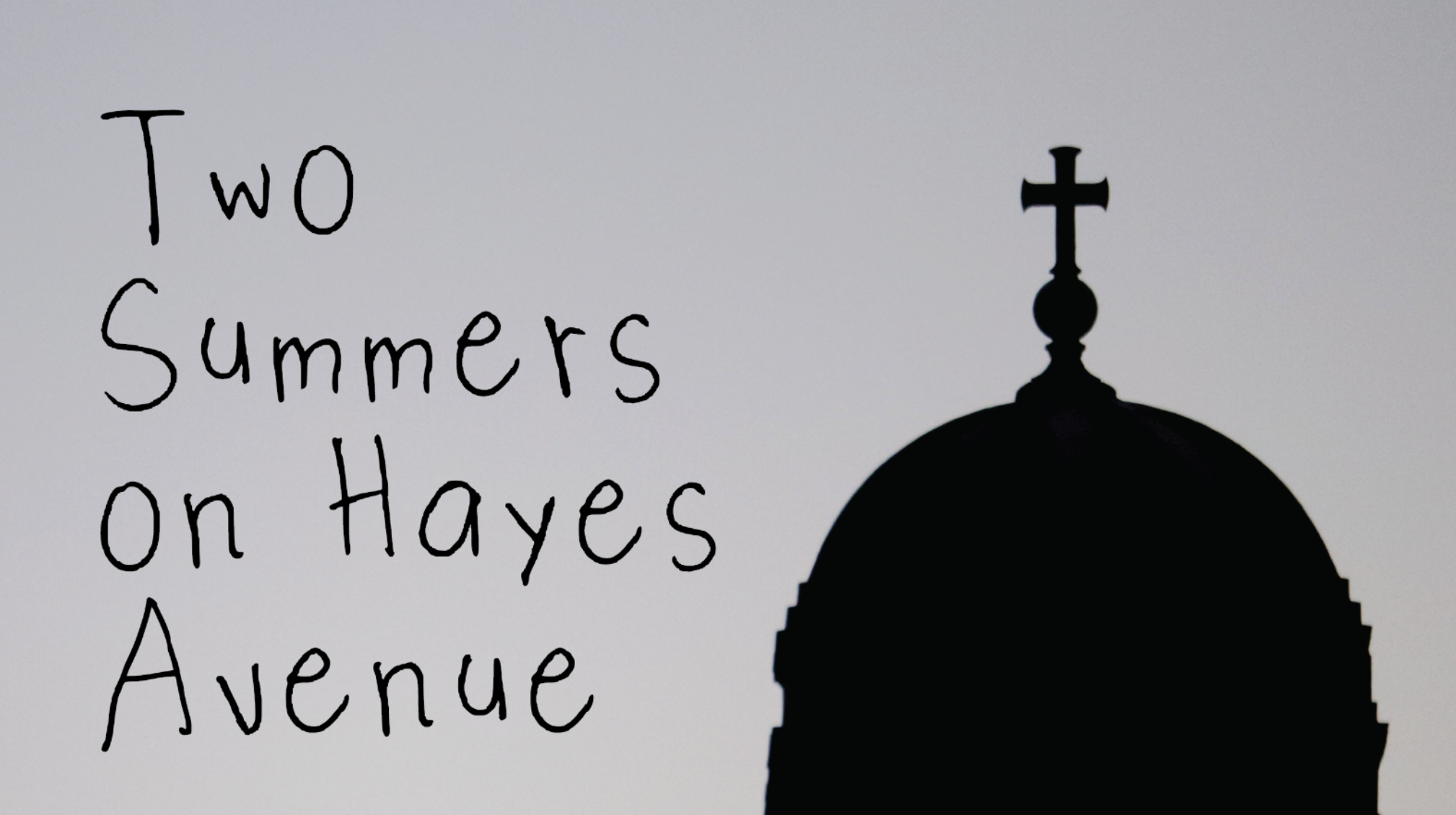
Join us for a screening of Two Summers on Hayes Avenue, a documentary examining the relationship between Rogers Park and Loyola University, looking to the future on how the university can better support the community, and how the community can better examine issues of gentrification and displacement in light of the current environment. A discussion will follow the screening.
Two Summers on Hayes Avenue is a project created by the production team of Tess Lacy, Lauren Sims, Elias Eshu, Emery Arevalo, Jo Swan, Nathan Yuen, Tenzin Chozom, and Dominic Bonelli, with Justin Anderson, Tara Lewis, Hnin Thazin, Solomon, and Vince Ahmadi. Screening discussions are imagined in partnership with the ONE Northside housing justice team, as well as other organizations around the city working for tenants rights and fighting rising rents, and educators in local public schools.
I was a little surprised when Tess asked me to share a story about my connection to the building at 1226 Loyola Avenue. She said she had seen how much energy I had put into raising awareness about Loyola’s unnecessary demolition of the building and wanted me to explain why it meant so much to me.
I had been to all the businesses on the ground floor — Archie’s, Roman Susan, and Edge Art – I had even been to the shoemaker who used to be there. I’ll admit, though, I wasn’t a regular at Salon Pastiche.
I would often walk past the building on my way to and from the train and on weekend nights, and I’d see people of all ages — Rogers Park residents, Loyola students, people from who knows where — standing and sitting on the sidewalk outside Archie’s enjoying the music, laughing, conversing – a diverse group of people just having a good time together.
Roman Susan had exhibits that were sometimes on-the-wall and sometimes off-the-wall — and one of the great things about it was that the art was often just as accessible – or even more accessible – to people walking by as to people walking in. No charge either way.
And Maggie’s Edge Art Gallery was filled with folk art Maggie collected on visits to Mexico. She would sell the art here, then take the proceeds — along with medicine and supplies — back with her on her next trip.
The building itself was a unique, structurally sound building that also provided low-income housing — something Chicago has a very short supply of. When the building was lost, we didn’t just lose a structure; we lost neighbors – people who were part of the fabric of the community.
So, when Tess asked why the building meant so much to me, I thought about it a while, and realized it was because the building was kind of a physical manifestation of what makes Rogers Park … Rogers Park.
When my wife and I moved here from the Pacific Northwest twenty-five years ago, we found an affordable apartment in the neighborhood. And even though I had lived in the Pacific Northwest for fifty years before that, Rogers Park felt more like home to me almost immediately.
Our new neighbors were friendly and welcoming. We could hear kids laughing outside Kilmer and Sullivan schools. And we had never seen as much diversity as we found here — people of different religions, ethnicities, languages, sexual identities, and incomes all sharing the same streets and respecting each other’s right to openly be who they are.
And when my wife died last year, there were more neighbors at her memorial than there were family members. This was where we belonged.
The demolition of the building at 1226 Loyola Avenue is heartbreaking. But the larger concern is Loyola’s ongoing pattern of land acquisition, demolition, and development that is steadily reshaping the neighborhood and pushing out the very people who make Rogers Park what it is.
What we’re seeing isn’t just the loss of buildings. It’s the gradual erosion of a culture and a community – and it needs to stop.
The first step in that direction is education. Tess has created a very impressive documentary that educated me – and will educate you – about specific details of what was going on behind the scenes that led up to the demolition. The film is an effective example of investigative journalism that lays out the facts, provides commentary, shows interviews with parties involved in the disputes, and in my case, inspired me to take action.
Rogers Park evolved its unique culture because generations of ordinary people cared enough to make it the community that it is. And if we want it to stay that way, it’s going to take people who care just as much today.
Two Summers on Hayes Avenue isn’t so much about a building, as it is about two very different visions of what a neighborhood should be. One vision sees Rogers Park as a community — a place where diversity is valued and where people of different incomes, backgrounds, and identities can live side by side.
The other sees Rogers Park primarily as real estate — land in an affordable neighborhood that can be acquired, redeveloped, and gentrified to increase its value and generate a net profit.
The reason I have invested the time and energy into raising awareness of Loyola’s demolition of the 1226 building, is that I believe the future of Rogers Park shouldn’t be decided by Loyola’s profit-driven Board of Trustees — it should be decided by the people who call it home.
–– Dave White

This event is being shared as part of Movement Studies – a programming series investigating social and environmental transitions. This project is partially supported by grants from the Illinois Arts Council Agency; Gaylord and Dorothy Donnelley Foundation; Reva and David Logan Foundation; Teiger Foundation; and through in-kind support from Chicago Park District. This event is being hosted with ONE Northside, a mixed-income, multi-ethnic, intergenerational organization that unites diverse communities. ONE Northside builds collective power to eliminate injustice through bold and innovative community organizing. For more information, visit onenorthside.org.
A tale of two Rogers Parks | Chicago Reader - May 19, 2026